Our Insights

What people search for often explains what happens next.

This Insight page shares selected observations from real search behaviour – where demand is growing, where it’s fading, and how brands, products and markets move over time.

19 Dec 2025

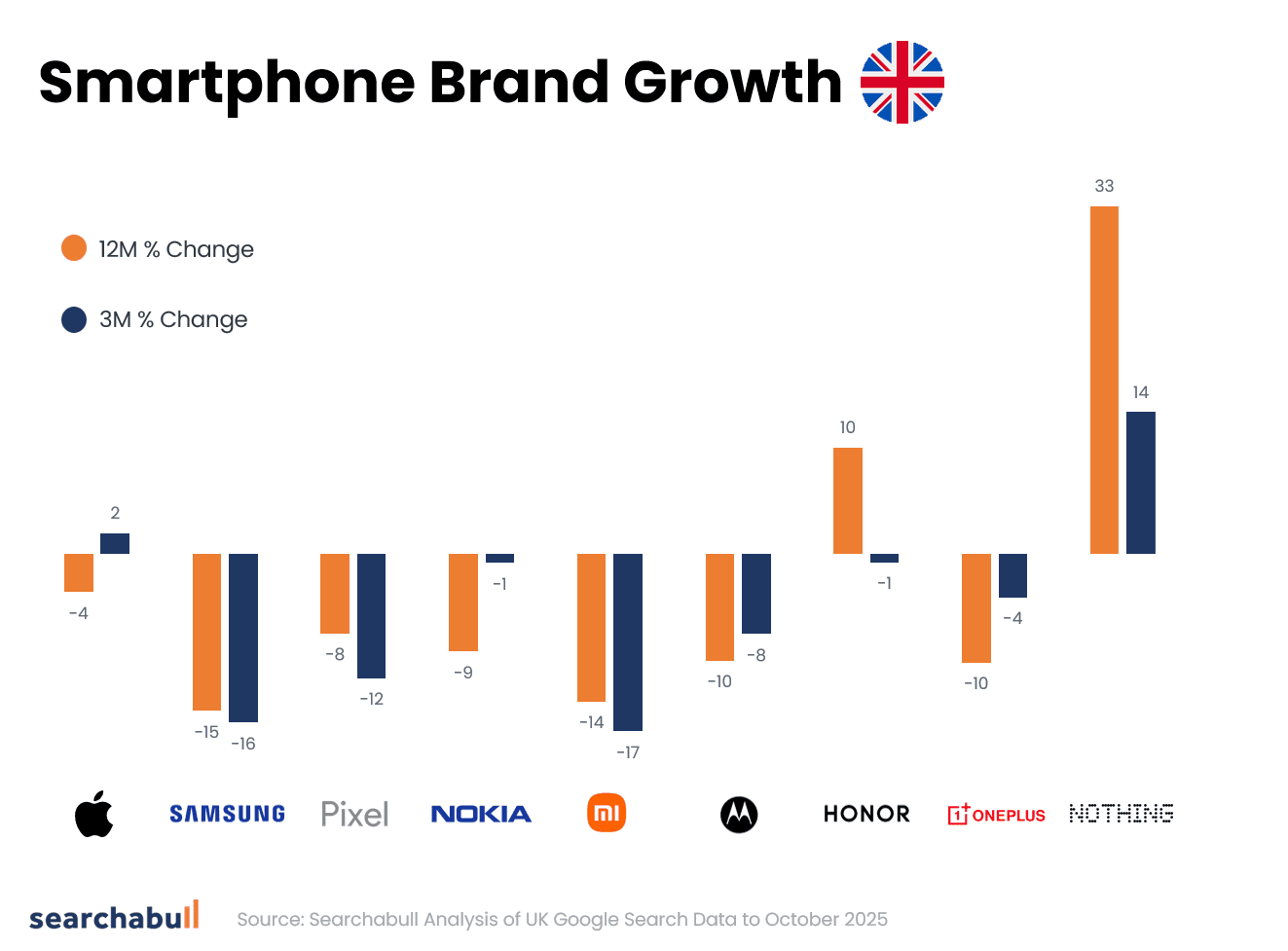
Smartphone Brand Growth – A Market Driven by Exceptions

UK smartphone search demand is softening overall, but headline growth figures show that not all brands are being affected equally.

Searchabull analysis reveals a market where broad-based decline is the norm, and growth is increasingly concentrated among a small number of brands that are successfully cutting through. This divergence is becoming more pronounced over time, reshaping competitive dynamics across the category.

Nothing’s momentum stands apart

Nothing continues to dominate UK search growth, clearly emerging as the fastest-growing smartphone brand across both short- and long-term measures.

Over the last:

  • 3 months, Nothing search demand has grown +14%

  • 12 months, growth reaches +33%

This dual-timeframe strength matters. It shows that Nothing’s momentum is not solely launch-driven, nor is it fading quickly after release windows. Instead, search behaviour suggests a compounding effect, where brand awareness, product interest, and ecosystem curiosity reinforce each other.

In a market where most brands are struggling to maintain demand, Nothing’s ability to grow across both horizons is highly unusual.

Honor’s growth eases as the market tightens

Honor’s trajectory tells a different story. After a strong period of expansion, recent data shows that growth has slowed sharply over the past three months.

This deceleration likely reflects a more competitive environment rather than a loss of relevance. As category demand softens, brands that previously benefited from favourable conditions are finding it harder to sustain momentum without major product or narrative shifts.

The next phase for Honor will depend on whether recent launches can re-ignite interest or whether growth normalises at a lower level.

Apple’s launch lift shows early signs of normalisation

Apple has seen a short-term uplift driven by interest in the iPhone 17, but early search signals suggest that demand is already easing back from launch highs.

This pattern is consistent with recent Apple cycles:

  • Strong, highly concentrated launch interest

  • Followed by gradual reversion as attention disperses

While Apple remains structurally dominant, its short-term growth figures highlight how even the strongest brands are not immune to broader market softening once launch momentum fades.

A category defined by decline – and concentration

Outside of Nothing, Apple, and Honor, all other major smartphone brands are in decline, both over the past 3 months and across the 12-month view.

This reflects a wider category reality:

  • Upgrade cycles are lengthening

  • Differentiation is harder to communicate

  • Consumer attention is becoming more selective

As a result, growth is no longer evenly distributed. Instead, it is flowing toward brands that can clearly articulate why they matter now, not just what they sell.

What this signals for 2026

The UK smartphone market is increasingly defined by exceptions rather than averages. Aggregate category performance hides the fact that a small number of brands are still capable of generating meaningful demand growth.

Looking ahead, key indicators to watch will be:

  • Whether Nothing can sustain growth without constant launches

  • Whether Honor’s recent slowdown is temporary or structural

  • How quickly Apple’s post-launch demand stabilises

  • Whether any mid-tier brands can reverse declining trajectories

In a softening market, growth is no longer about keeping pace. It is about standing apart.

19 Dec 2025

Smartphone Brand Growth – A Market Driven by Exceptions

UK smartphone search demand is softening overall, but headline growth figures show that not all brands are being affected equally.

Searchabull analysis reveals a market where broad-based decline is the norm, and growth is increasingly concentrated among a small number of brands that are successfully cutting through. This divergence is becoming more pronounced over time, reshaping competitive dynamics across the category.

Nothing’s momentum stands apart

Nothing continues to dominate UK search growth, clearly emerging as the fastest-growing smartphone brand across both short- and long-term measures.

Over the last:

  • 3 months, Nothing search demand has grown +14%

  • 12 months, growth reaches +33%

This dual-timeframe strength matters. It shows that Nothing’s momentum is not solely launch-driven, nor is it fading quickly after release windows. Instead, search behaviour suggests a compounding effect, where brand awareness, product interest, and ecosystem curiosity reinforce each other.

In a market where most brands are struggling to maintain demand, Nothing’s ability to grow across both horizons is highly unusual.

Honor’s growth eases as the market tightens

Honor’s trajectory tells a different story. After a strong period of expansion, recent data shows that growth has slowed sharply over the past three months.

This deceleration likely reflects a more competitive environment rather than a loss of relevance. As category demand softens, brands that previously benefited from favourable conditions are finding it harder to sustain momentum without major product or narrative shifts.

The next phase for Honor will depend on whether recent launches can re-ignite interest or whether growth normalises at a lower level.

Apple’s launch lift shows early signs of normalisation

Apple has seen a short-term uplift driven by interest in the iPhone 17, but early search signals suggest that demand is already easing back from launch highs.

This pattern is consistent with recent Apple cycles:

  • Strong, highly concentrated launch interest

  • Followed by gradual reversion as attention disperses

While Apple remains structurally dominant, its short-term growth figures highlight how even the strongest brands are not immune to broader market softening once launch momentum fades.

A category defined by decline – and concentration

Outside of Nothing, Apple, and Honor, all other major smartphone brands are in decline, both over the past 3 months and across the 12-month view.

This reflects a wider category reality:

  • Upgrade cycles are lengthening

  • Differentiation is harder to communicate

  • Consumer attention is becoming more selective

As a result, growth is no longer evenly distributed. Instead, it is flowing toward brands that can clearly articulate why they matter now, not just what they sell.

What this signals for 2026

The UK smartphone market is increasingly defined by exceptions rather than averages. Aggregate category performance hides the fact that a small number of brands are still capable of generating meaningful demand growth.

Looking ahead, key indicators to watch will be:

  • Whether Nothing can sustain growth without constant launches

  • Whether Honor’s recent slowdown is temporary or structural

  • How quickly Apple’s post-launch demand stabilises

  • Whether any mid-tier brands can reverse declining trajectories

In a softening market, growth is no longer about keeping pace. It is about standing apart.

15 Jan 2026

Nothing is no longer behaving like a challenger smartphone brand.

Search data shows it is increasingly being treated as a multi-product consumer electronics brand, with audio now acting as a major engine of demand growth.

Over the past 12 months, search interest in Nothing’s audio portfolio has accelerated sharply – despite a wider audio market that is showing signs of softening. This divergence is important: it suggests Nothing’s growth is being driven by brand momentum and product relevance, not just category tailwinds.

A standout performance in France - and beyond

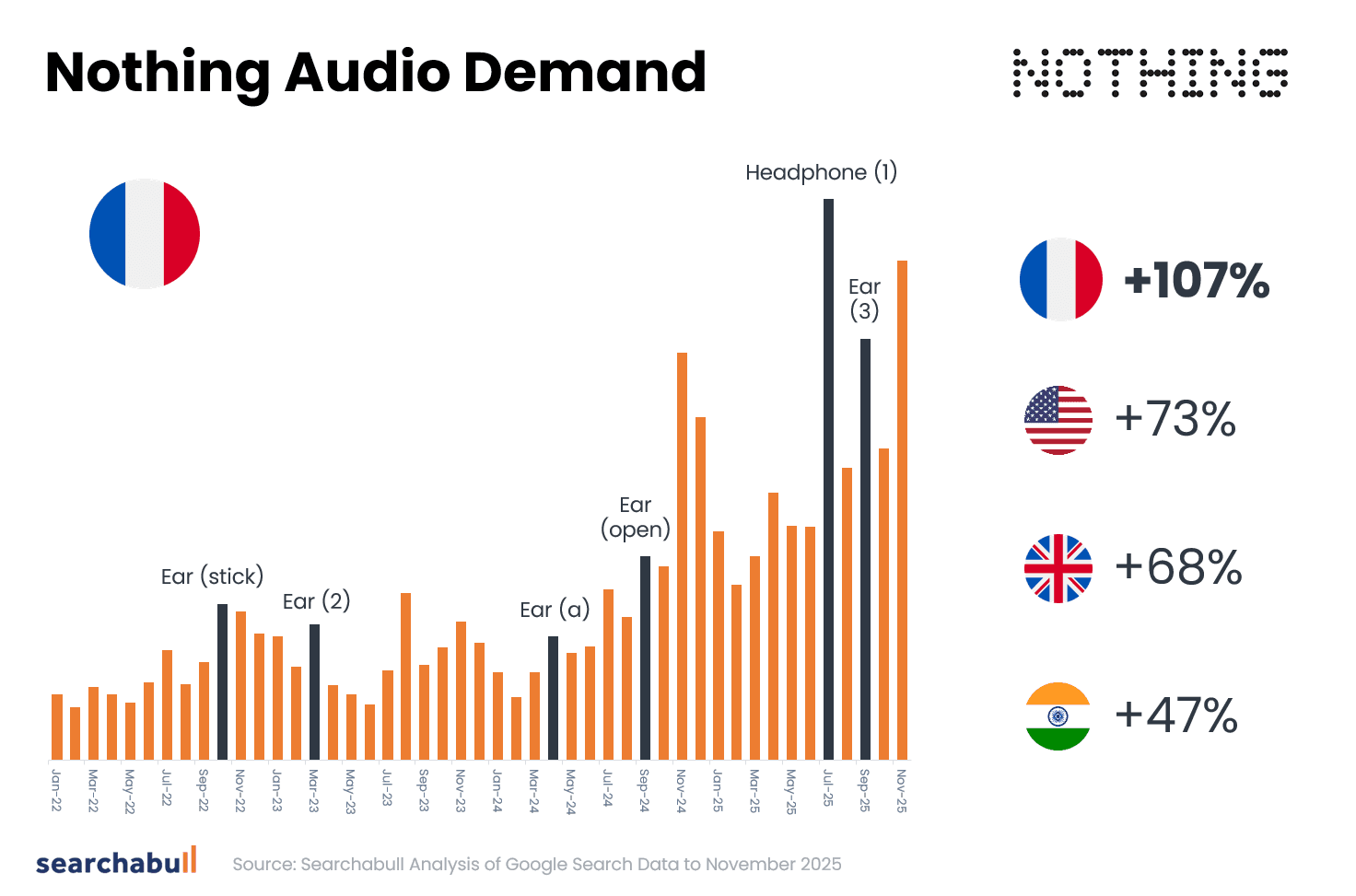
France has emerged as the clear breakout market, with Nothing audio searches up +107% year-on-year. This is not a marginal uplift – it represents a step-change in demand that puts France well ahead of other major markets.

The momentum is not isolated:

  • The USA has grown +73%

  • The UK is up +68%

  • India continues to expand at +47%, from a much larger base

What’s striking here is the European skew. Europe appears to be increasingly “Nothing-first”, with users actively searching for the brand rather than discovering it incidentally. This points to growing brand salience, not just product curiosity.

Product launches as inflection points, not spikes

The timing of demand acceleration aligns closely with the launches of Headphone (1) and Ear (3) in 2025. However, the pattern in search behaviour suggests more than short-term launch spikes.

Instead of peaking and normalising, search demand has continued to build, pushing audio interest to all-time highs. This implies that these products are not just generating attention, but pulling new users into the Nothing ecosystem.

From a search perspective, that distinction matters. Sustained growth indicates:

  • Repeat consideration

  • Broader product exploration

  • A shift from novelty-driven searches to brand-led demand

A strategic split: Europe vs India

While Europe is driving headline growth, India remains a different – but equally important – story.

India continues to act as the volume powerhouse for CMF-branded products, reflecting a more value-led, accessory-focused dynamic. Europe, by contrast, is behaving like a core Nothing market, where users are engaging directly with flagship audio products under the main brand.

This split reinforces the idea that Nothing is successfully running two complementary strategies:

  • Brand-led ecosystem expansion in Europe and the US

  • Scale and accessibility through CMF in India

What this signals next

Nothing’s audio performance is a strong indicator that its ecosystem strategy may be approaching a tipping point. The key question is whether audio becomes:

  • A sustained second pillar alongside smartphones, or

  • A launch-driven surge that fades once novelty declines

Search data over the next 6–12 months will be critical here. If audio demand remains elevated outside of launch windows, it would confirm that Nothing is no longer just competing on devices – but on brand relevance across categories.

15 Jan 2026

Nothing is no longer behaving like a challenger smartphone brand.

Search data shows it is increasingly being treated as a multi-product consumer electronics brand, with audio now acting as a major engine of demand growth.

Over the past 12 months, search interest in Nothing’s audio portfolio has accelerated sharply – despite a wider audio market that is showing signs of softening. This divergence is important: it suggests Nothing’s growth is being driven by brand momentum and product relevance, not just category tailwinds.

A standout performance in France - and beyond

France has emerged as the clear breakout market, with Nothing audio searches up +107% year-on-year. This is not a marginal uplift – it represents a step-change in demand that puts France well ahead of other major markets.

The momentum is not isolated:

  • The USA has grown +73%

  • The UK is up +68%

  • India continues to expand at +47%, from a much larger base

What’s striking here is the European skew. Europe appears to be increasingly “Nothing-first”, with users actively searching for the brand rather than discovering it incidentally. This points to growing brand salience, not just product curiosity.

Product launches as inflection points, not spikes

The timing of demand acceleration aligns closely with the launches of Headphone (1) and Ear (3) in 2025. However, the pattern in search behaviour suggests more than short-term launch spikes.

Instead of peaking and normalising, search demand has continued to build, pushing audio interest to all-time highs. This implies that these products are not just generating attention, but pulling new users into the Nothing ecosystem.

From a search perspective, that distinction matters. Sustained growth indicates:

  • Repeat consideration

  • Broader product exploration

  • A shift from novelty-driven searches to brand-led demand

A strategic split: Europe vs India

While Europe is driving headline growth, India remains a different – but equally important – story.

India continues to act as the volume powerhouse for CMF-branded products, reflecting a more value-led, accessory-focused dynamic. Europe, by contrast, is behaving like a core Nothing market, where users are engaging directly with flagship audio products under the main brand.

This split reinforces the idea that Nothing is successfully running two complementary strategies:

  • Brand-led ecosystem expansion in Europe and the US

  • Scale and accessibility through CMF in India

What this signals next

Nothing’s audio performance is a strong indicator that its ecosystem strategy may be approaching a tipping point. The key question is whether audio becomes:

  • A sustained second pillar alongside smartphones, or

  • A launch-driven surge that fades once novelty declines

Search data over the next 6–12 months will be critical here. If audio demand remains elevated outside of launch windows, it would confirm that Nothing is no longer just competing on devices – but on brand relevance across categories.

17 Dec 2025

Smart Ring Demand – Is the Category Entering Its Next Phase?

After two years of near-continuous growth, UK search demand for smart rings may be showing its first signs of stabilisation.

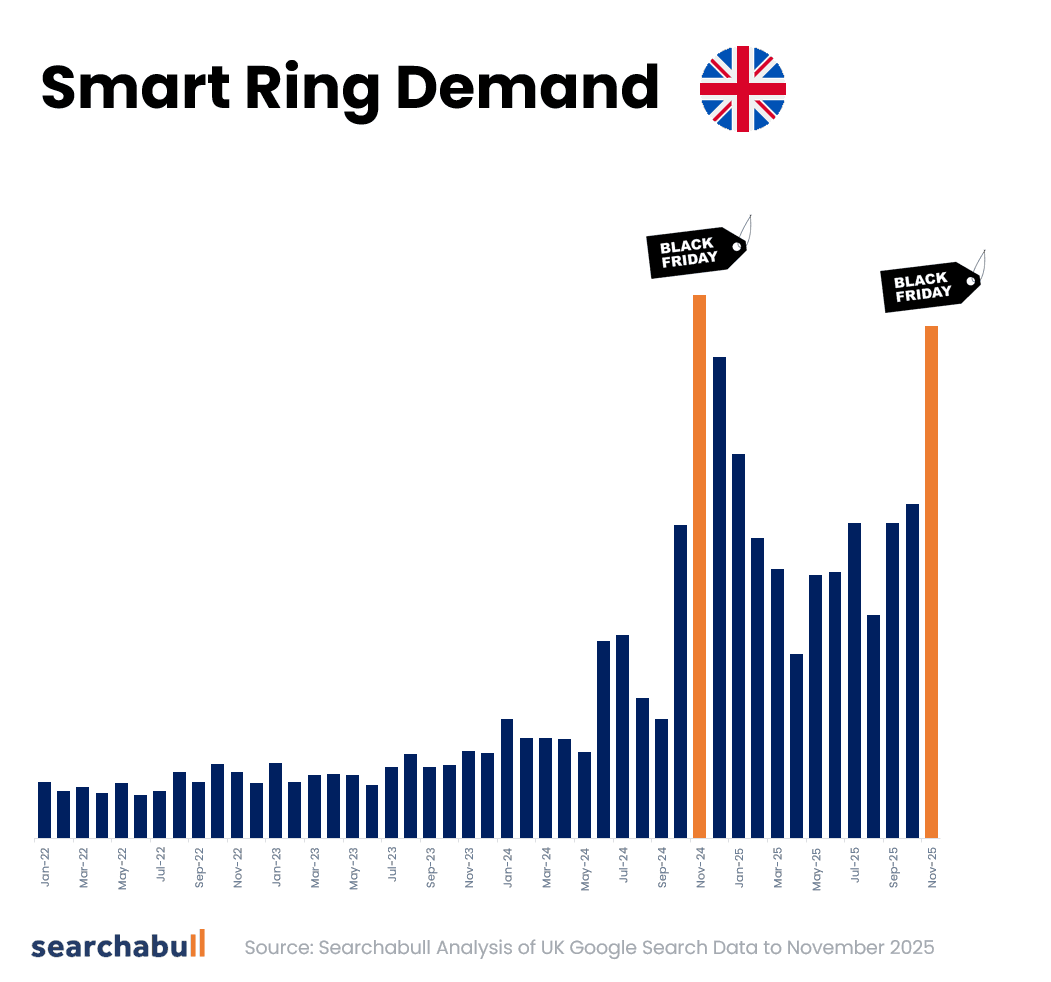
November 2025 marked the first month in which smart ring search demand failed to grow, breaking a long-standing upward trend. On its own, that would already be notable. The fact that it occurred during Black Friday, traditionally the strongest demand period of the year, makes the shift far more significant.

This does not signal decline – but it does suggest the category may be transitioning out of its early expansion phase.

From rapid growth to consolidation

Since 2023, smart rings have benefited from a powerful combination of factors:

  • Increased focus on health and sleep tracking

  • Broader awareness driven by major tech brands

  • Clear differentiation versus smartwatches

Search behaviour reflected this clearly, with demand accelerating year after year and peaking sharply around key retail moments such as Black Friday.

November’s plateau suggests that early adopters may now be largely captured, and that incremental growth is becoming harder to generate through promotion alone.

Why Black Friday matters here

Black Friday acts as a stress test for category momentum. If demand continues to rise during this period, it usually indicates:

  • Untapped mainstream interest

  • Strong perceived value

  • Expanding consideration beyond niche users

The absence of growth this year implies that smart rings may be losing their novelty premium, at least among UK consumers. Interest remains high, but it is no longer accelerating automatically.

Samsung’s role – and what happens next

Samsung played a crucial role in scaling awareness of the category. Its entry helped legitimise smart rings as a credible health device rather than a niche wearable.

However, search data suggests Samsung’s presence may now be less expansionary than it once was. As the brand appears to step back from aggressively pushing the category, the question becomes whether other players can sustain momentum.

This matters because early category growth was driven as much by brand validation as by product capability.

The next growth lever: positioning, not hype

The next phase of smart ring growth is unlikely to come from louder marketing or deeper discounts. Instead, search behaviour points toward a shift in narrative.

Newer players like Leep are beginning to change how smart rings are framed:

  • Less emphasis on hype-driven launches

  • Fewer subscription-heavy propositions

  • Greater focus on everyday usefulness, trust, and longevity

This repositioning aligns with a more mature audience – users who are interested, but sceptical, and who need clearer reasons to engage.

What this signals for the category

A plateau in search demand does not mean the category has peaked – but it does suggest it is at an inflection point.

Future growth is likely to depend on:

  • Clearer use cases beyond sleep and recovery

  • Stronger differentiation between brands

  • Reduced friction around pricing, subscriptions, and data trust

If smart rings can successfully reposition from “new wearable” to “essential health tool”, demand could reaccelerate. If not, growth may remain steady but subdued.

What to watch next

Search data over the next 6–12 months will be critical in determining which path the category takes. In particular:

  • Whether demand rebounds during the next major retail cycle

  • Which brands continue to grow once novelty-driven interest fades

  • How search language evolves, signalling shifts in consumer expectations

The smart ring category is no longer just about awareness. The next wave of growth will be about earning trust and proving long-term value.

17 Dec 2025

Smart Ring Demand – Is the Category Entering Its Next Phase?

After two years of near-continuous growth, UK search demand for smart rings may be showing its first signs of stabilisation.

November 2025 marked the first month in which smart ring search demand failed to grow, breaking a long-standing upward trend. On its own, that would already be notable. The fact that it occurred during Black Friday, traditionally the strongest demand period of the year, makes the shift far more significant.

This does not signal decline – but it does suggest the category may be transitioning out of its early expansion phase.

From rapid growth to consolidation

Since 2023, smart rings have benefited from a powerful combination of factors:

  • Increased focus on health and sleep tracking

  • Broader awareness driven by major tech brands

  • Clear differentiation versus smartwatches

Search behaviour reflected this clearly, with demand accelerating year after year and peaking sharply around key retail moments such as Black Friday.

November’s plateau suggests that early adopters may now be largely captured, and that incremental growth is becoming harder to generate through promotion alone.

Why Black Friday matters here

Black Friday acts as a stress test for category momentum. If demand continues to rise during this period, it usually indicates:

  • Untapped mainstream interest

  • Strong perceived value

  • Expanding consideration beyond niche users

The absence of growth this year implies that smart rings may be losing their novelty premium, at least among UK consumers. Interest remains high, but it is no longer accelerating automatically.

Samsung’s role – and what happens next

Samsung played a crucial role in scaling awareness of the category. Its entry helped legitimise smart rings as a credible health device rather than a niche wearable.

However, search data suggests Samsung’s presence may now be less expansionary than it once was. As the brand appears to step back from aggressively pushing the category, the question becomes whether other players can sustain momentum.

This matters because early category growth was driven as much by brand validation as by product capability.

The next growth lever: positioning, not hype

The next phase of smart ring growth is unlikely to come from louder marketing or deeper discounts. Instead, search behaviour points toward a shift in narrative.

Newer players like Leep are beginning to change how smart rings are framed:

  • Less emphasis on hype-driven launches

  • Fewer subscription-heavy propositions

  • Greater focus on everyday usefulness, trust, and longevity

This repositioning aligns with a more mature audience – users who are interested, but sceptical, and who need clearer reasons to engage.

What this signals for the category

A plateau in search demand does not mean the category has peaked – but it does suggest it is at an inflection point.

Future growth is likely to depend on:

  • Clearer use cases beyond sleep and recovery

  • Stronger differentiation between brands

  • Reduced friction around pricing, subscriptions, and data trust

If smart rings can successfully reposition from “new wearable” to “essential health tool”, demand could reaccelerate. If not, growth may remain steady but subdued.

What to watch next

Search data over the next 6–12 months will be critical in determining which path the category takes. In particular:

  • Whether demand rebounds during the next major retail cycle

  • Which brands continue to grow once novelty-driven interest fades

  • How search language evolves, signalling shifts in consumer expectations

The smart ring category is no longer just about awareness. The next wave of growth will be about earning trust and proving long-term value.

23 Oct 2025

Apple Reasserts Control With Latest Flagship Launch

Apple’s iPhone 17 launch has delivered its strongest search performance in over four years, marking a decisive return to dominance in the UK smartphone market.

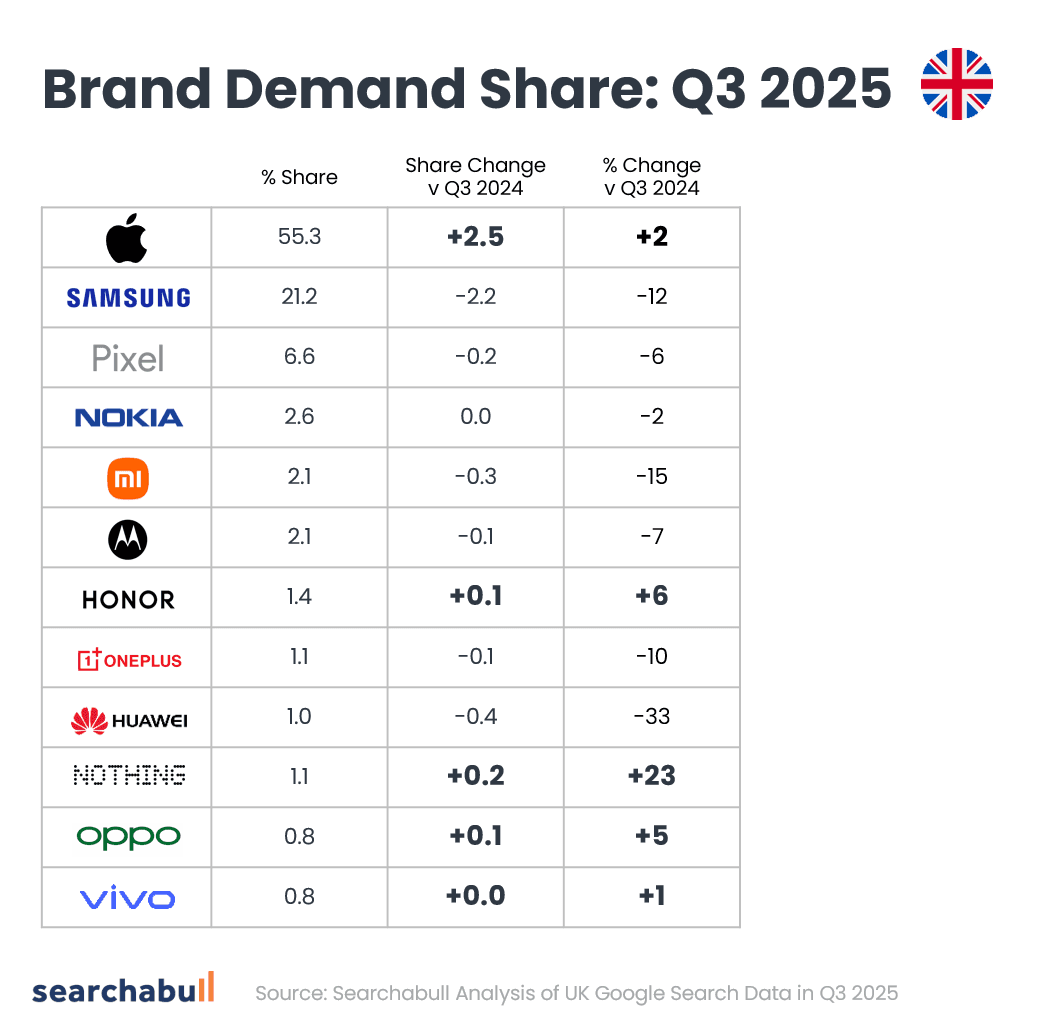
Searchabull data shows Apple captured 55.3% of total UK smartphone search demand in Q3 2025, its highest quarterly share since 2021. September alone peaked at 66% share, underlining just how concentrated consumer attention became during the launch window.

This was not simply a seasonal uplift. It represents a clear turnaround following several years of more fragmented demand, where challenger brands and Android alternatives steadily chipped away at Apple’s share of attention.

A launch that cut through the noise

Recent iPhone launches have often generated strong spikes, but this cycle stands out for both scale and clarity. Search behaviour indicates that consumer interest was highly focused, with less diffusion across alternative brands than in previous years.

From a demand-share perspective, this matters. High concentration suggests:

  • Clear product relevance

  • Strong narrative alignment across models

  • Reduced consideration leakage to competitors

In short, Apple didn’t just win the launch – it absorbed demand that would normally spill into the wider market.

Samsung under pressure from both sides

Samsung was the most exposed to Apple’s resurgence. Its UK search share fell to 21.2%, the lowest level seen in four years.

This decline reflects a dual pressure:

  • At the top end, Apple’s launch compressed premium consideration

  • At the mid and lower tiers, challenger brands continued to gain traction

Samsung’s position remains strong in absolute terms, but search behaviour suggests its portfolio is currently being squeezed between a highly successful iPhone cycle and increasingly credible alternatives elsewhere in the market.

Challenger brands quietly reshaping the market

While Apple dominated headlines, the most interesting shifts occurred further down the table.

Nothing recorded the fastest growth of any brand, up +23% quarter-on-quarter, driven by the launch of Nothing Phone (3). Although its overall share remains modest, the growth rate signals rising brand salience rather than one-off curiosity.

Honor continued to expand (+6%), though at a slower pace than its exceptional +21% growth last year. This deceleration suggests Honor is moving from breakout phase into a more competitive, consolidated position.

Oppo and vivo also gained share from smaller bases, reinforcing a longer-term pattern: UK search demand is becoming more fragmented outside the top two brands, even when Apple is performing strongly.

What this tells us about the UK market

Two dynamics are playing out simultaneously:

  1. Apple remains uniquely capable of recentralising demand when a launch resonates

  2. Structural diversification continues beneath the surface, with challengers steadily building presence over time

This combination creates volatility in quarterly share data, but also opportunity. Brands that can grow during periods of Apple dominance are likely strengthening their long-term position.

What to watch next

The key question following Q3 is sustainability. Apple’s performance sets a high benchmark, but history shows that post-launch normalisation is inevitable.

The next signals to watch in search data will be:

  • How quickly Apple’s share settles post-launch

  • Whether Samsung regains lost ground or continues to leak demand

  • Which challenger brands retain momentum once launch-driven spikes fade

Search behaviour over Q4 and early 2026 will determine whether this quarter marks a temporary peak or the start of a renewed cycle of Apple-led dominance in the UK.

23 Oct 2025

Apple Reasserts Control With Latest Flagship Launch

Apple’s iPhone 17 launch has delivered its strongest search performance in over four years, marking a decisive return to dominance in the UK smartphone market.

Searchabull data shows Apple captured 55.3% of total UK smartphone search demand in Q3 2025, its highest quarterly share since 2021. September alone peaked at 66% share, underlining just how concentrated consumer attention became during the launch window.

This was not simply a seasonal uplift. It represents a clear turnaround following several years of more fragmented demand, where challenger brands and Android alternatives steadily chipped away at Apple’s share of attention.

A launch that cut through the noise

Recent iPhone launches have often generated strong spikes, but this cycle stands out for both scale and clarity. Search behaviour indicates that consumer interest was highly focused, with less diffusion across alternative brands than in previous years.

From a demand-share perspective, this matters. High concentration suggests:

  • Clear product relevance

  • Strong narrative alignment across models

  • Reduced consideration leakage to competitors

In short, Apple didn’t just win the launch – it absorbed demand that would normally spill into the wider market.

Samsung under pressure from both sides

Samsung was the most exposed to Apple’s resurgence. Its UK search share fell to 21.2%, the lowest level seen in four years.

This decline reflects a dual pressure:

  • At the top end, Apple’s launch compressed premium consideration

  • At the mid and lower tiers, challenger brands continued to gain traction

Samsung’s position remains strong in absolute terms, but search behaviour suggests its portfolio is currently being squeezed between a highly successful iPhone cycle and increasingly credible alternatives elsewhere in the market.

Challenger brands quietly reshaping the market

While Apple dominated headlines, the most interesting shifts occurred further down the table.

Nothing recorded the fastest growth of any brand, up +23% quarter-on-quarter, driven by the launch of Nothing Phone (3). Although its overall share remains modest, the growth rate signals rising brand salience rather than one-off curiosity.

Honor continued to expand (+6%), though at a slower pace than its exceptional +21% growth last year. This deceleration suggests Honor is moving from breakout phase into a more competitive, consolidated position.

Oppo and vivo also gained share from smaller bases, reinforcing a longer-term pattern: UK search demand is becoming more fragmented outside the top two brands, even when Apple is performing strongly.

What this tells us about the UK market

Two dynamics are playing out simultaneously:

  1. Apple remains uniquely capable of recentralising demand when a launch resonates

  2. Structural diversification continues beneath the surface, with challengers steadily building presence over time

This combination creates volatility in quarterly share data, but also opportunity. Brands that can grow during periods of Apple dominance are likely strengthening their long-term position.

What to watch next

The key question following Q3 is sustainability. Apple’s performance sets a high benchmark, but history shows that post-launch normalisation is inevitable.

The next signals to watch in search data will be:

  • How quickly Apple’s share settles post-launch

  • Whether Samsung regains lost ground or continues to leak demand

  • Which challenger brands retain momentum once launch-driven spikes fade

Search behaviour over Q4 and early 2026 will determine whether this quarter marks a temporary peak or the start of a renewed cycle of Apple-led dominance in the UK.

16 Apr 2025

MWC 2025 Model Demand Ranking – When Launch Hype Becomes Brand Momentum

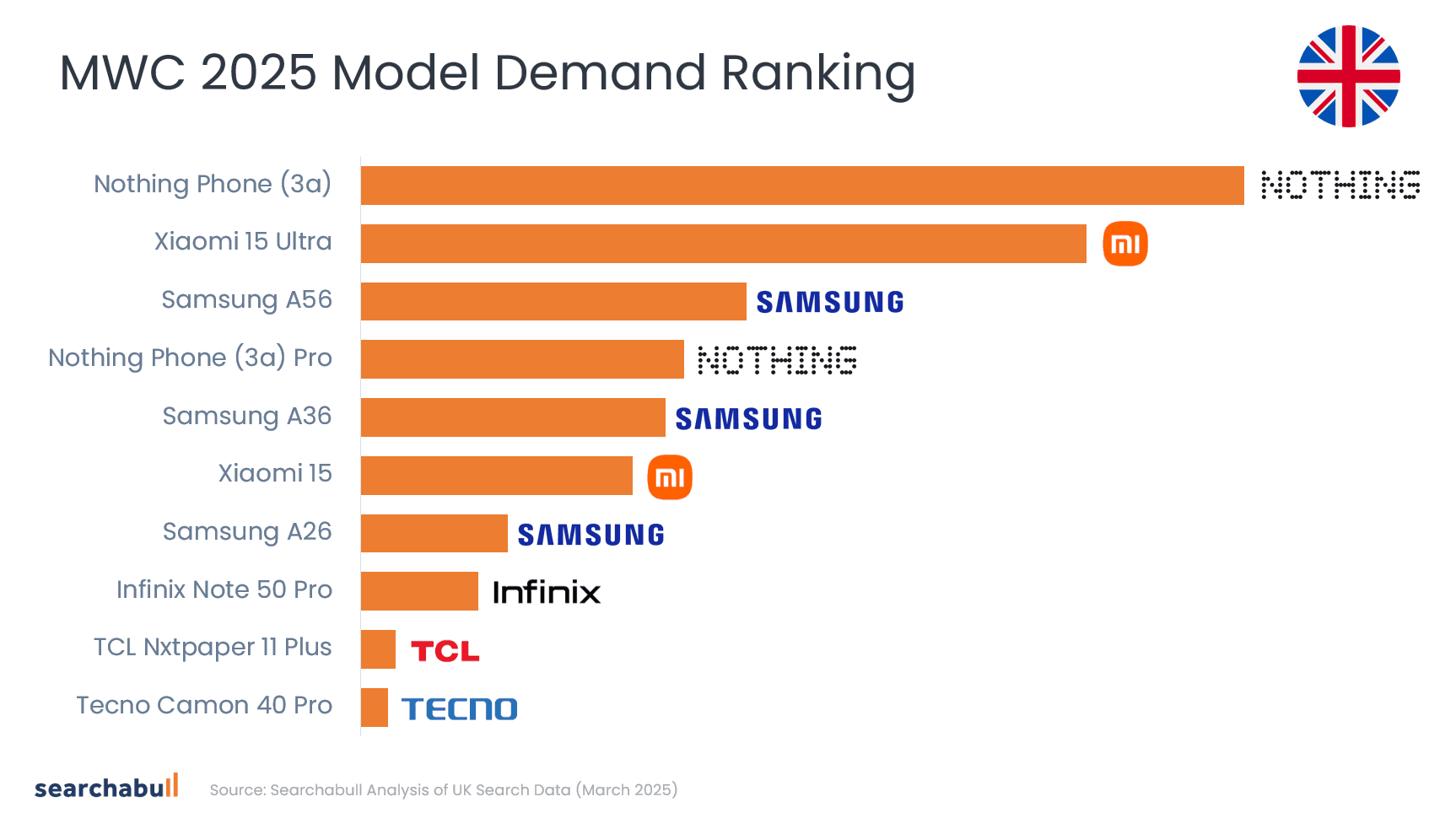
Nothing emerged as the clear standout brand at MWC 2025, dominating consumer search demand for newly launched smartphone models in the UK.

Searchabull analysis shows that Nothing Phone (3a) generated the highest level of search interest of any model announced at the event, with Phone (3a) Pro also ranking 4th. No other brand placed more than one model near the top of the ranking, highlighting the scale and concentration of Nothing’s launch impact.

In a crowded MWC line-up, Nothing didn’t just perform well – it cut through decisively.

A launch that translated into real demand

MWC launches often generate visibility without sustained follow-through. What sets Nothing apart here is that search behaviour indicates genuine consumer pull, not just momentary attention.

Phone (3a)’s demand was:

  • +12% higher than last year’s Phone (2a)

  • +56% higher when combining Phone (3a) and Phone (3a) Pro, compared to Nothing’s total MWC 2024 performance

This scale of uplift suggests that the launch resonated beyond existing fans, drawing in new consideration rather than recycling prior interest.

From product success to brand movement

The impact of MWC extended beyond individual models. In the month following the event, Nothing climbed from 12th to 6th place in UK smartphone brand rankings, overtaking established competitors including Honor, Sony, OnePlus, and Oppo.

That shift matters. Brand-level movement indicates that users were not only searching for a single product, but exploring Nothing more broadly – a critical signal for long-term growth.

Search behaviour here reflects a common pattern seen in successful ecosystem brands:

  • Model-level interest triggers wider brand discovery

  • Brand discovery reinforces future product demand

  • Momentum compounds rather than dissipates

Why Nothing stood out at MWC 2025

Several factors likely contributed to Nothing’s outsized performance:

  • Clear differentiation in design and positioning

  • Accessible pricing relative to flagship competitors

  • A consistent narrative that aligned product, brand, and audience

In contrast, many competing launches struggled to distinguish themselves, resulting in fragmented and lower-intensity search interest across models.

MWC rewarded clarity. Nothing delivered it.

The critical question: momentum or moment?

While Nothing’s MWC performance was exceptional, the more important question is what happens next.

Search data consistently shows that launch success alone is not enough. Brands that fail to convert attention into sustained relevance often see demand fall back sharply once the event cycle ends.

Early signals following MWC 2025 were encouraging, but longer-term confirmation would require:

  • Continued model-level demand outside launch windows

  • Stable or rising brand share over subsequent quarters

  • Evidence that new users return, not just arrive once

What to watch next

Nothing has a track record of effective launches. MWC 2025 reinforces that reputation. The challenge now is repetition and durability.

Key indicators to monitor include:

  • Post-launch demand curves for Phone (3a) and Pro

  • Spillover effects into other Nothing product categories

  • Whether brand growth persists without a major new release

If Nothing can sustain momentum beyond MWC, this launch may be remembered not just as a standout event performance, but as a turning point in the brand’s trajectory.

16 Apr 2025

MWC 2025 Model Demand Ranking – When Launch Hype Becomes Brand Momentum

Nothing emerged as the clear standout brand at MWC 2025, dominating consumer search demand for newly launched smartphone models in the UK.

Searchabull analysis shows that Nothing Phone (3a) generated the highest level of search interest of any model announced at the event, with Phone (3a) Pro also ranking 4th. No other brand placed more than one model near the top of the ranking, highlighting the scale and concentration of Nothing’s launch impact.

In a crowded MWC line-up, Nothing didn’t just perform well – it cut through decisively.

A launch that translated into real demand

MWC launches often generate visibility without sustained follow-through. What sets Nothing apart here is that search behaviour indicates genuine consumer pull, not just momentary attention.

Phone (3a)’s demand was:

  • +12% higher than last year’s Phone (2a)

  • +56% higher when combining Phone (3a) and Phone (3a) Pro, compared to Nothing’s total MWC 2024 performance

This scale of uplift suggests that the launch resonated beyond existing fans, drawing in new consideration rather than recycling prior interest.

From product success to brand movement

The impact of MWC extended beyond individual models. In the month following the event, Nothing climbed from 12th to 6th place in UK smartphone brand rankings, overtaking established competitors including Honor, Sony, OnePlus, and Oppo.

That shift matters. Brand-level movement indicates that users were not only searching for a single product, but exploring Nothing more broadly – a critical signal for long-term growth.

Search behaviour here reflects a common pattern seen in successful ecosystem brands:

  • Model-level interest triggers wider brand discovery

  • Brand discovery reinforces future product demand

  • Momentum compounds rather than dissipates

Why Nothing stood out at MWC 2025

Several factors likely contributed to Nothing’s outsized performance:

  • Clear differentiation in design and positioning

  • Accessible pricing relative to flagship competitors

  • A consistent narrative that aligned product, brand, and audience

In contrast, many competing launches struggled to distinguish themselves, resulting in fragmented and lower-intensity search interest across models.

MWC rewarded clarity. Nothing delivered it.

The critical question: momentum or moment?

While Nothing’s MWC performance was exceptional, the more important question is what happens next.

Search data consistently shows that launch success alone is not enough. Brands that fail to convert attention into sustained relevance often see demand fall back sharply once the event cycle ends.

Early signals following MWC 2025 were encouraging, but longer-term confirmation would require:

  • Continued model-level demand outside launch windows

  • Stable or rising brand share over subsequent quarters

  • Evidence that new users return, not just arrive once

What to watch next

Nothing has a track record of effective launches. MWC 2025 reinforces that reputation. The challenge now is repetition and durability.

Key indicators to monitor include:

  • Post-launch demand curves for Phone (3a) and Pro

  • Spillover effects into other Nothing product categories

  • Whether brand growth persists without a major new release

If Nothing can sustain momentum beyond MWC, this launch may be remembered not just as a standout event performance, but as a turning point in the brand’s trajectory.

27 Jan 2025

UK Smart Ring Demand – When Competition Accelerates a Category

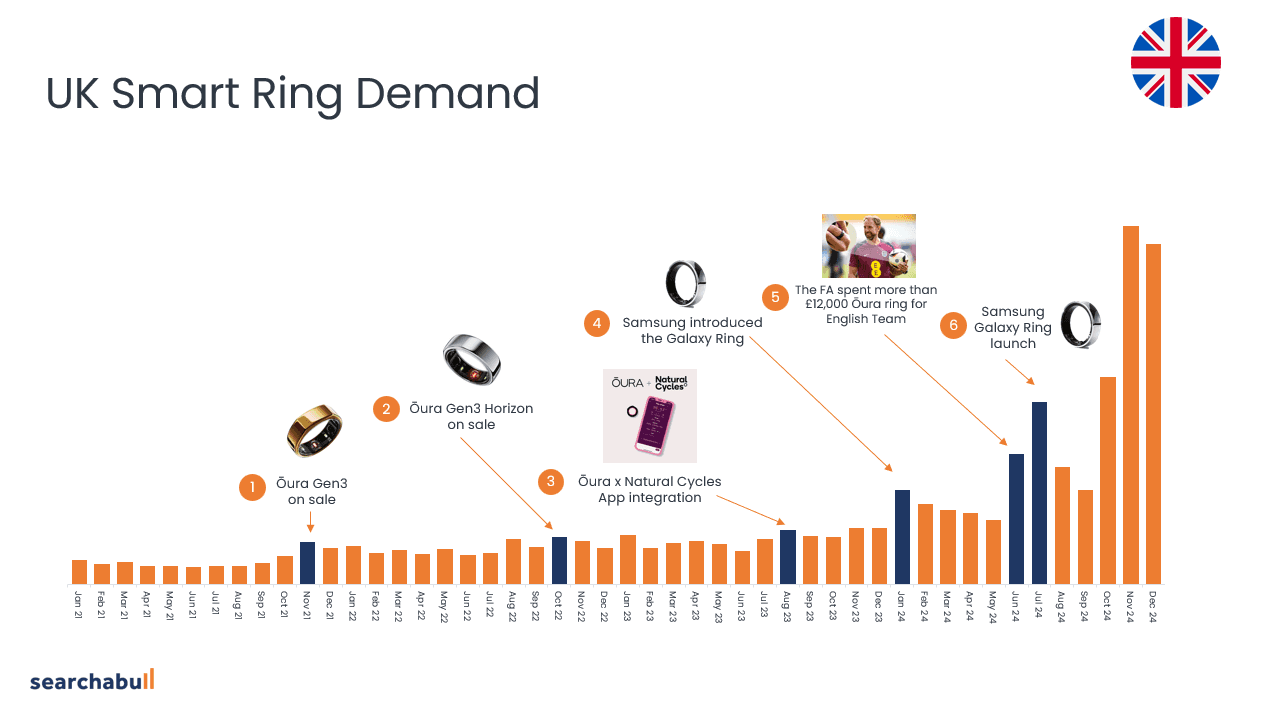
The launch of the Samsung Galaxy Ring may ultimately prove to be the single most important moment in the UK smart ring category’s development – not just for Samsung, but for the market leader it was supposed to challenge.

Rather than fragmenting demand, Samsung’s entry acted as a category accelerator, dramatically expanding awareness, consideration, and overall search interest. In doing so, it lifted the entire market – including Oura, the brand it was most directly competing against.

A step-change in category growth

UK smart ring search demand grew by +230% in 2024, a sharp acceleration compared to the +26% growth recorded the year before. This is not incremental growth; it represents a structural shift in how visible and understood the category has become.

Search behaviour shows that smart rings moved from being a niche, enthusiast-led product to a mainstream health and wearable consideration, driven largely by increased exposure and legitimacy.

Samsung’s involvement mattered because it reframed the category:

  • From experimental to credible

  • From niche to mass-market relevant

  • From “what is this?” to “which one should I buy?”

Oura grows faster – even as share falls

Oura remains the dominant force in the category and, somewhat counterintuitively, appears to have benefited most from Samsung’s entry.

In 2024:

  • Oura’s search demand grew by +200%

  • Market share declined by around 10% vs 2023

On the surface, a share decline might appear negative. In reality, this represents a highly favourable trade-off. Oura more than doubled its demand in absolute terms, even as new entrants expanded the market around it.

This is a classic category expansion dynamic: the leader gives up some share, but gains far more in scale.

Samsung builds presence, but not dominance

Samsung has steadily increased demand since the Galaxy Ring launch, reaching a 13% market share by Christmas.

This is a solid performance for a first-generation product and indicates growing consumer interest. However, search data suggests Samsung remains a challenger rather than a disruptor at this stage.

While Samsung may have outperformed Oura in short-term growth rates during parts of the year, it has not yet threatened Oura’s position as the default smart ring brand in the UK.

The implication is clear: awareness alone is not enough. Leadership in this category still depends on credibility, depth, and trust, not just scale.

Smaller players show promise – but remain niche

Ultrahuman continued to deliver strong growth throughout 2024, reinforcing its position as a credible alternative for more informed or specialist users.

However, with market share holding at around 4%, search behaviour indicates that it remains a niche player rather than a mass-market contender. Growth is coming from a relatively narrow audience, not broad-based adoption.

This highlights a key challenge for emerging brands: expanding beyond early adopters without losing clarity of proposition.

The next wave has not yet arrived

Despite rapid growth, the smart ring category is still in an early phase. Several major potential entrants – including Honor, Huawei, and potentially Apple – have yet to launch products.

Their entry would likely trigger:

  • Another step-change in category awareness

  • Further redistribution of share

  • A new phase of competitive positioning

Search data will be critical in understanding whether future growth comes from:

  • New users entering the category, or

  • Existing interest being reshuffled between brands

What this tells us about the category’s future

The smart ring market is no longer proving its relevance – it has already done that. The next challenge is definition.

Future growth will depend on:

  • Clear differentiation between products

  • Stronger articulation of use cases beyond early health tracking

  • Reduced friction around subscriptions, pricing, and data trust

Samsung’s launch validated the category. Oura’s response shows how incumbents can thrive when a market expands rather than fragments.

The next chapter will be about who owns the category narrative, not who arrived first.

27 Jan 2025

UK Smart Ring Demand – When Competition Accelerates a Category

The launch of the Samsung Galaxy Ring may ultimately prove to be the single most important moment in the UK smart ring category’s development – not just for Samsung, but for the market leader it was supposed to challenge.

Rather than fragmenting demand, Samsung’s entry acted as a category accelerator, dramatically expanding awareness, consideration, and overall search interest. In doing so, it lifted the entire market – including Oura, the brand it was most directly competing against.

A step-change in category growth

UK smart ring search demand grew by +230% in 2024, a sharp acceleration compared to the +26% growth recorded the year before. This is not incremental growth; it represents a structural shift in how visible and understood the category has become.

Search behaviour shows that smart rings moved from being a niche, enthusiast-led product to a mainstream health and wearable consideration, driven largely by increased exposure and legitimacy.

Samsung’s involvement mattered because it reframed the category:

  • From experimental to credible

  • From niche to mass-market relevant

  • From “what is this?” to “which one should I buy?”

Oura grows faster – even as share falls

Oura remains the dominant force in the category and, somewhat counterintuitively, appears to have benefited most from Samsung’s entry.

In 2024:

  • Oura’s search demand grew by +200%

  • Market share declined by around 10% vs 2023

On the surface, a share decline might appear negative. In reality, this represents a highly favourable trade-off. Oura more than doubled its demand in absolute terms, even as new entrants expanded the market around it.

This is a classic category expansion dynamic: the leader gives up some share, but gains far more in scale.

Samsung builds presence, but not dominance

Samsung has steadily increased demand since the Galaxy Ring launch, reaching a 13% market share by Christmas.

This is a solid performance for a first-generation product and indicates growing consumer interest. However, search data suggests Samsung remains a challenger rather than a disruptor at this stage.

While Samsung may have outperformed Oura in short-term growth rates during parts of the year, it has not yet threatened Oura’s position as the default smart ring brand in the UK.

The implication is clear: awareness alone is not enough. Leadership in this category still depends on credibility, depth, and trust, not just scale.

Smaller players show promise – but remain niche

Ultrahuman continued to deliver strong growth throughout 2024, reinforcing its position as a credible alternative for more informed or specialist users.

However, with market share holding at around 4%, search behaviour indicates that it remains a niche player rather than a mass-market contender. Growth is coming from a relatively narrow audience, not broad-based adoption.

This highlights a key challenge for emerging brands: expanding beyond early adopters without losing clarity of proposition.

The next wave has not yet arrived

Despite rapid growth, the smart ring category is still in an early phase. Several major potential entrants – including Honor, Huawei, and potentially Apple – have yet to launch products.

Their entry would likely trigger:

  • Another step-change in category awareness

  • Further redistribution of share

  • A new phase of competitive positioning

Search data will be critical in understanding whether future growth comes from:

  • New users entering the category, or

  • Existing interest being reshuffled between brands

What this tells us about the category’s future

The smart ring market is no longer proving its relevance – it has already done that. The next challenge is definition.

Future growth will depend on:

  • Clear differentiation between products

  • Stronger articulation of use cases beyond early health tracking

  • Reduced friction around subscriptions, pricing, and data trust

Samsung’s launch validated the category. Oura’s response shows how incumbents can thrive when a market expands rather than fragments.

The next chapter will be about who owns the category narrative, not who arrived first.
Contact Us

Ready to Power Your Business Decisions with Real Consumer Data?

Whether you need to understand your brand, your category, or your competition, we can build a monitor tailored to your market and data needs

Contact Us

Ready to Power Your Business Decisions with Real Consumer Data?

Whether you need to understand your brand, your category, or your competition, we can build a monitor tailored to your market and data needs

Contact Us

Ready to Power Your Business Decisions with Real Consumer Data?

Whether you need to understand your brand, your category, or your competition, we can build a monitor tailored to your market and data needs