17 Dec 2025
Smart Ring Demand – Is the Category Entering Its Next Phase?
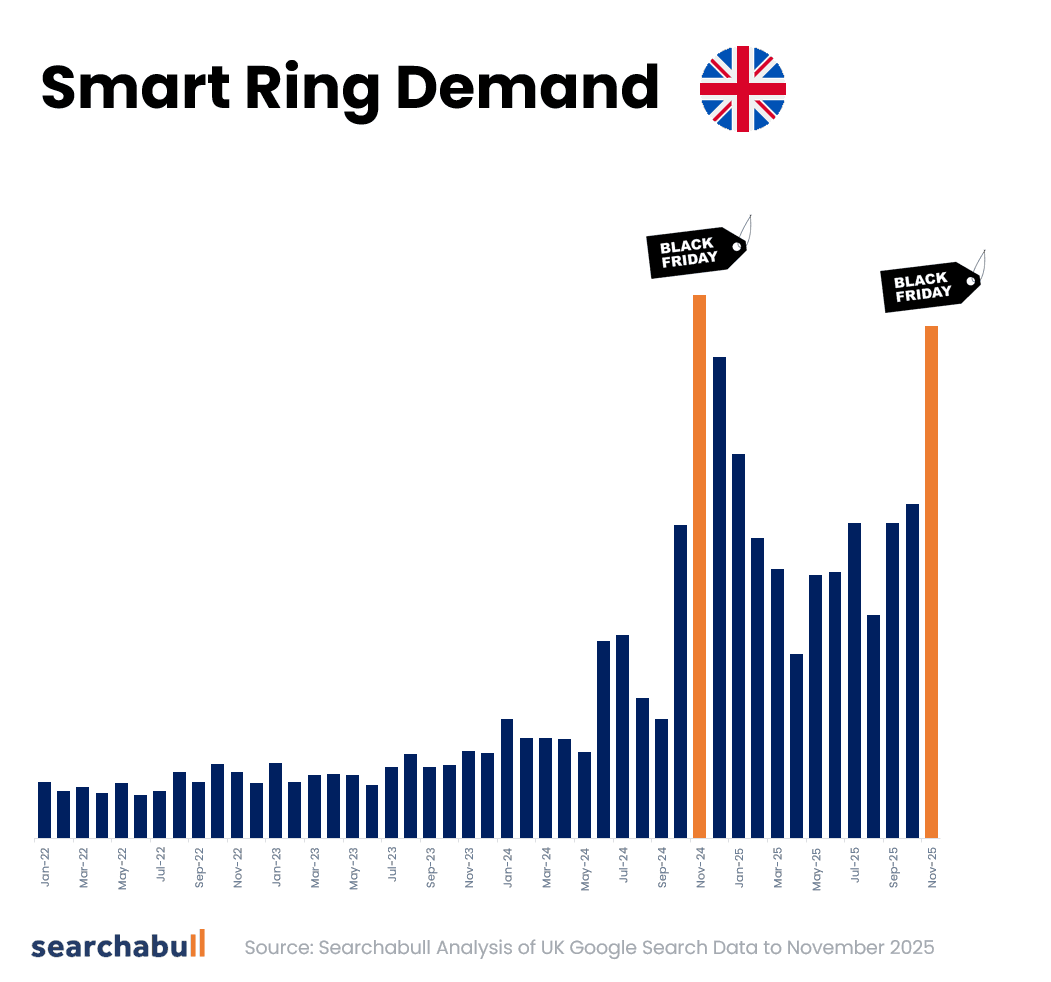
After two years of near-continuous growth, UK search demand for smart rings may be showing its first signs of stabilisation.
November 2025 marked the first month in which smart ring search demand failed to grow, breaking a long-standing upward trend. On its own, that would already be notable. The fact that it occurred during Black Friday, traditionally the strongest demand period of the year, makes the shift far more significant.
This does not signal decline – but it does suggest the category may be transitioning out of its early expansion phase.
From rapid growth to consolidation
Since 2023, smart rings have benefited from a powerful combination of factors:
Increased focus on health and sleep tracking
Broader awareness driven by major tech brands
Clear differentiation versus smartwatches
Search behaviour reflected this clearly, with demand accelerating year after year and peaking sharply around key retail moments such as Black Friday.
November’s plateau suggests that early adopters may now be largely captured, and that incremental growth is becoming harder to generate through promotion alone.
Why Black Friday matters here
Black Friday acts as a stress test for category momentum. If demand continues to rise during this period, it usually indicates:
Untapped mainstream interest
Strong perceived value
Expanding consideration beyond niche users
The absence of growth this year implies that smart rings may be losing their novelty premium, at least among UK consumers. Interest remains high, but it is no longer accelerating automatically.
Samsung’s role – and what happens next
Samsung played a crucial role in scaling awareness of the category. Its entry helped legitimise smart rings as a credible health device rather than a niche wearable.
However, search data suggests Samsung’s presence may now be less expansionary than it once was. As the brand appears to step back from aggressively pushing the category, the question becomes whether other players can sustain momentum.
This matters because early category growth was driven as much by brand validation as by product capability.
The next growth lever: positioning, not hype
The next phase of smart ring growth is unlikely to come from louder marketing or deeper discounts. Instead, search behaviour points toward a shift in narrative.
Newer players like Leep are beginning to change how smart rings are framed:
Less emphasis on hype-driven launches
Fewer subscription-heavy propositions
Greater focus on everyday usefulness, trust, and longevity
This repositioning aligns with a more mature audience – users who are interested, but sceptical, and who need clearer reasons to engage.
What this signals for the category
A plateau in search demand does not mean the category has peaked – but it does suggest it is at an inflection point.
Future growth is likely to depend on:
Clearer use cases beyond sleep and recovery
Stronger differentiation between brands
Reduced friction around pricing, subscriptions, and data trust
If smart rings can successfully reposition from “new wearable” to “essential health tool”, demand could reaccelerate. If not, growth may remain steady but subdued.
What to watch next
Search data over the next 6–12 months will be critical in determining which path the category takes. In particular:
Whether demand rebounds during the next major retail cycle
Which brands continue to grow once novelty-driven interest fades
How search language evolves, signalling shifts in consumer expectations
The smart ring category is no longer just about awareness. The next wave of growth will be about earning trust and proving long-term value.

Contact Us
Ready to Power Your Business Decisions with Real Consumer Data?
Whether you need to understand your brand, your category, or your competition, we can build a monitor tailored to your market and data needs
Contact