27 Jan 2025
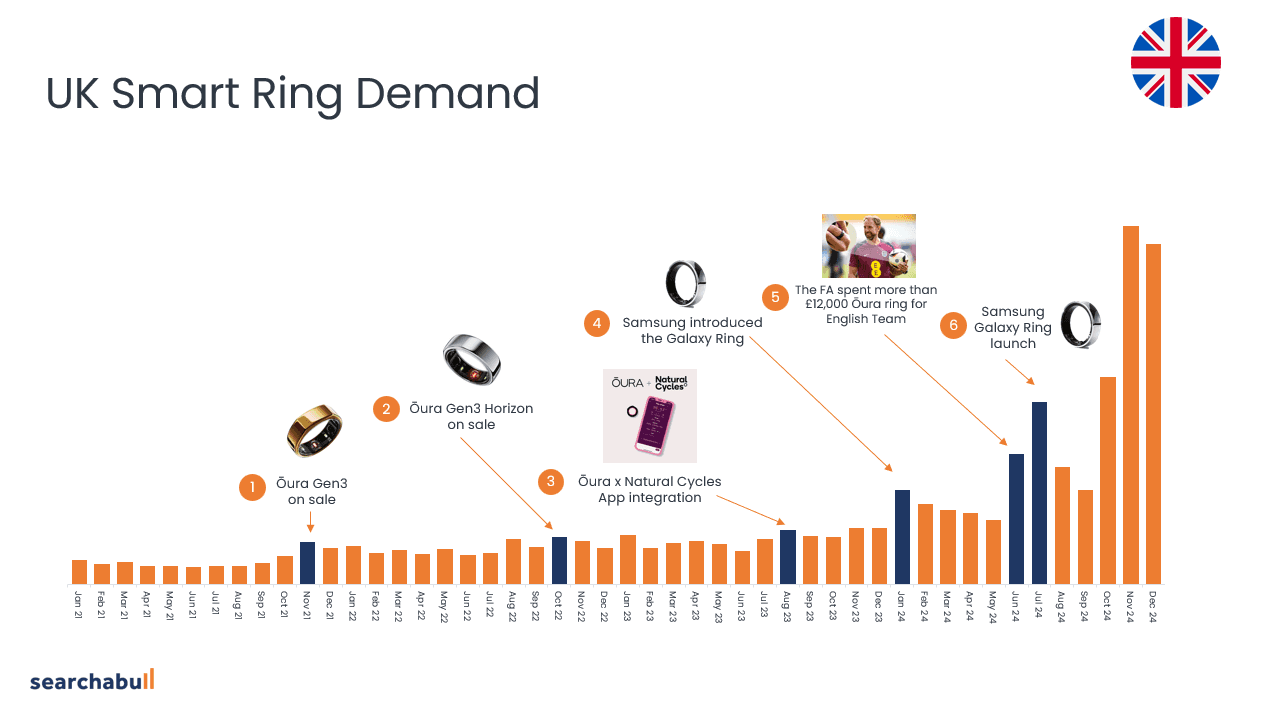
UK Smart Ring Demand – When Competition Accelerates a Category
The launch of the Samsung Galaxy Ring may ultimately prove to be the single most important moment in the UK smart ring category’s development – not just for Samsung, but for the market leader it was supposed to challenge.
Rather than fragmenting demand, Samsung’s entry acted as a category accelerator, dramatically expanding awareness, consideration, and overall search interest. In doing so, it lifted the entire market – including Oura, the brand it was most directly competing against.
A step-change in category growth
UK smart ring search demand grew by +230% in 2024, a sharp acceleration compared to the +26% growth recorded the year before. This is not incremental growth; it represents a structural shift in how visible and understood the category has become.
Search behaviour shows that smart rings moved from being a niche, enthusiast-led product to a mainstream health and wearable consideration, driven largely by increased exposure and legitimacy.
Samsung’s involvement mattered because it reframed the category:
From experimental to credible
From niche to mass-market relevant
From “what is this?” to “which one should I buy?”
Oura grows faster – even as share falls
Oura remains the dominant force in the category and, somewhat counterintuitively, appears to have benefited most from Samsung’s entry.
In 2024:
Oura’s search demand grew by +200%
Market share declined by around 10% vs 2023
On the surface, a share decline might appear negative. In reality, this represents a highly favourable trade-off. Oura more than doubled its demand in absolute terms, even as new entrants expanded the market around it.
This is a classic category expansion dynamic: the leader gives up some share, but gains far more in scale.
Samsung builds presence, but not dominance
Samsung has steadily increased demand since the Galaxy Ring launch, reaching a 13% market share by Christmas.
This is a solid performance for a first-generation product and indicates growing consumer interest. However, search data suggests Samsung remains a challenger rather than a disruptor at this stage.
While Samsung may have outperformed Oura in short-term growth rates during parts of the year, it has not yet threatened Oura’s position as the default smart ring brand in the UK.
The implication is clear: awareness alone is not enough. Leadership in this category still depends on credibility, depth, and trust, not just scale.
Smaller players show promise – but remain niche
Ultrahuman continued to deliver strong growth throughout 2024, reinforcing its position as a credible alternative for more informed or specialist users.
However, with market share holding at around 4%, search behaviour indicates that it remains a niche player rather than a mass-market contender. Growth is coming from a relatively narrow audience, not broad-based adoption.
This highlights a key challenge for emerging brands: expanding beyond early adopters without losing clarity of proposition.
The next wave has not yet arrived
Despite rapid growth, the smart ring category is still in an early phase. Several major potential entrants – including Honor, Huawei, and potentially Apple – have yet to launch products.
Their entry would likely trigger:
Another step-change in category awareness
Further redistribution of share
A new phase of competitive positioning
Search data will be critical in understanding whether future growth comes from:
New users entering the category, or
Existing interest being reshuffled between brands
What this tells us about the category’s future
The smart ring market is no longer proving its relevance – it has already done that. The next challenge is definition.
Future growth will depend on:
Clear differentiation between products
Stronger articulation of use cases beyond early health tracking
Reduced friction around subscriptions, pricing, and data trust
Samsung’s launch validated the category. Oura’s response shows how incumbents can thrive when a market expands rather than fragments.
The next chapter will be about who owns the category narrative, not who arrived first.

Contact Us
Ready to Power Your Business Decisions with Real Consumer Data?
Whether you need to understand your brand, your category, or your competition, we can build a monitor tailored to your market and data needs
Contact