23 Oct 2025
Apple Reasserts Control With Latest Flagship Launch
Apple’s iPhone 17 launch has delivered its strongest search performance in over four years, marking a decisive return to dominance in the UK smartphone market.
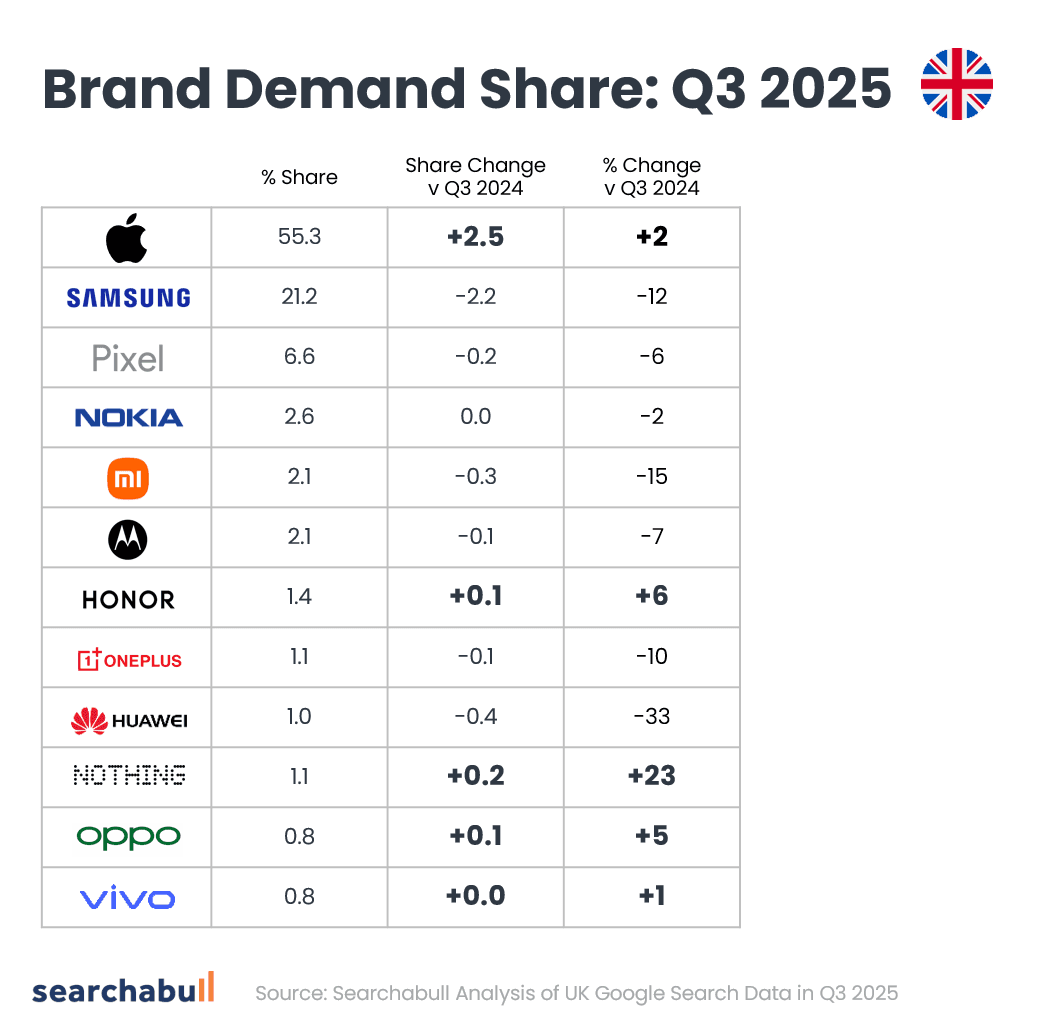
Searchabull data shows Apple captured 55.3% of total UK smartphone search demand in Q3 2025, its highest quarterly share since 2021. September alone peaked at 66% share, underlining just how concentrated consumer attention became during the launch window.
This was not simply a seasonal uplift. It represents a clear turnaround following several years of more fragmented demand, where challenger brands and Android alternatives steadily chipped away at Apple’s share of attention.
A launch that cut through the noise
Recent iPhone launches have often generated strong spikes, but this cycle stands out for both scale and clarity. Search behaviour indicates that consumer interest was highly focused, with less diffusion across alternative brands than in previous years.
From a demand-share perspective, this matters. High concentration suggests:
Clear product relevance
Strong narrative alignment across models
Reduced consideration leakage to competitors
In short, Apple didn’t just win the launch – it absorbed demand that would normally spill into the wider market.
Samsung under pressure from both sides
Samsung was the most exposed to Apple’s resurgence. Its UK search share fell to 21.2%, the lowest level seen in four years.
This decline reflects a dual pressure:
At the top end, Apple’s launch compressed premium consideration
At the mid and lower tiers, challenger brands continued to gain traction
Samsung’s position remains strong in absolute terms, but search behaviour suggests its portfolio is currently being squeezed between a highly successful iPhone cycle and increasingly credible alternatives elsewhere in the market.
Challenger brands quietly reshaping the market
While Apple dominated headlines, the most interesting shifts occurred further down the table.
Nothing recorded the fastest growth of any brand, up +23% quarter-on-quarter, driven by the launch of Nothing Phone (3). Although its overall share remains modest, the growth rate signals rising brand salience rather than one-off curiosity.
Honor continued to expand (+6%), though at a slower pace than its exceptional +21% growth last year. This deceleration suggests Honor is moving from breakout phase into a more competitive, consolidated position.
Oppo and vivo also gained share from smaller bases, reinforcing a longer-term pattern: UK search demand is becoming more fragmented outside the top two brands, even when Apple is performing strongly.
What this tells us about the UK market
Two dynamics are playing out simultaneously:
Apple remains uniquely capable of recentralising demand when a launch resonates
Structural diversification continues beneath the surface, with challengers steadily building presence over time
This combination creates volatility in quarterly share data, but also opportunity. Brands that can grow during periods of Apple dominance are likely strengthening their long-term position.
What to watch next
The key question following Q3 is sustainability. Apple’s performance sets a high benchmark, but history shows that post-launch normalisation is inevitable.
The next signals to watch in search data will be:
How quickly Apple’s share settles post-launch
Whether Samsung regains lost ground or continues to leak demand
Which challenger brands retain momentum once launch-driven spikes fade
Search behaviour over Q4 and early 2026 will determine whether this quarter marks a temporary peak or the start of a renewed cycle of Apple-led dominance in the UK.

Contact Us
Ready to Power Your Business Decisions with Real Consumer Data?
Whether you need to understand your brand, your category, or your competition, we can build a monitor tailored to your market and data needs
Contact